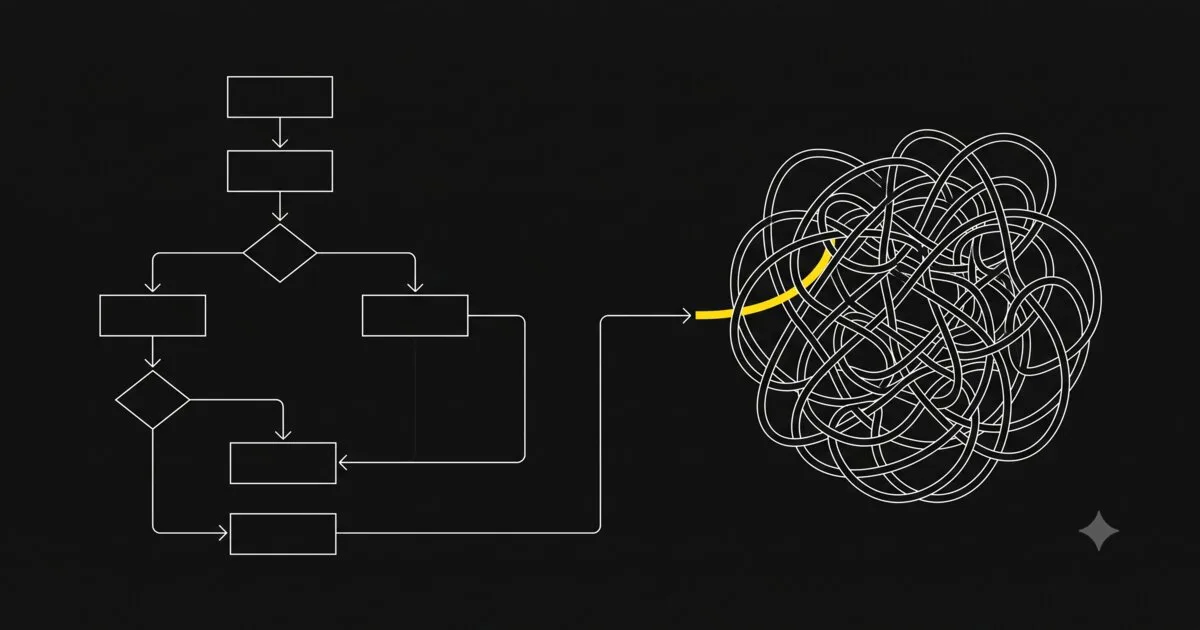
Every vendor selling an AI-powered course builder or no-code app generator makes the same promise: describe your methodology, get a working tool, same day. The promise isn't a lie. It's incomplete. It holds exactly until your framework has enough real structure to matter, and then it stops.
What the demo actually proves
Forbes recently profiled coaches using "vibe coding": building tools by describing what they want to an AI, no developer required. Goal-tracking dashboards, pre-session prep tools, outcome calculators, built in a day and embedded in Notion, Kajabi, or Thinkific. Course-authoring platforms make a similar promise from the content side: feed Nolej a PDF and it generates an interactive course, quizzes included, in minutes, and Colossyan does the same for training video, letting you regenerate a single lesson instead of rebuilding the whole course when something changes.
Both are real. Neither is the whole story. What these examples actually prove is that a demo-sized piece of structure converts cleanly. A methodology with three steps and a linear flow survives the conversion fine. That's not the same claim as "your framework becomes an app."
Where it breaks
A widely discussed thread among builders working this way, summarized by the developer tooling site morphllm.com, names the actual failure mode: ask the AI to fix one unrelated thing, and it rewrites code that was already working, forgets decisions it made a few prompts earlier, regenerates logic that conflicts with what you already built. None of this shows up in a five-minute demo. All of it shows up once a framework has more than a handful of interdependent rules.
That's the real dividing line, and it has nothing to do with how good the AI is at writing code. A framework built over years of client work isn't a flowchart, it's exceptions to the flowchart: the judgment call you make when a client doesn't fit the standard case. Vibe coding tools optimize for getting something on screen fast, not for holding years of accumulated exceptions without quietly breaking one of them.
The same pattern shows up in the writing
This isn't only a tooling problem. It shows up in writing too. Structural work, outlining a chapter, restructuring a section, tightening an argument, is a bounded task with a clear right answer. Generating finished prose and then rewriting it isn't. Ask an AI to draft the paragraph and you've traded writing time for editing time, and the edit often takes longer than writing it yourself would have.
The shape of the failure is identical in both cases. Bounded, narrow tasks hold up; broad, complex ones don't survive contact with the real thing unless a person is actively holding the structure together. A podcast transcript turned into three social captions works because the task is small. A decade of consulting methodology typed into a chatbot for an afternoon doesn't, for the same reason a novel doesn't write itself just because a language model can draft a paragraph.
"A framework built over years of client work isn't a flowchart. It's exceptions to the flowchart."
Dana Snyder built an AI-powered consulting platform for nonprofits using Replit's AI tools, with no technical background. It generates fundraising strategies and program names from an agent loaded with her own methodology, work that used to take hours of billable time. The detail usually left out of the pitch: it took her six months, not a day, and she's still the one running it, watching it, deciding what the agent gets to do. That's the actual difference between a demo and a tool. Not the AI. The build time, and a person who keeps deciding what stays theirs to control. If you've spent years building something real, a book, a curriculum, a framework, a methodology, the version worth putting in front of clients isn't the one that survives an afternoon of prompting. It's the one built with the same care you put into the original.